1 What Is Lusha? Company Overview, Features & Limitations
Lusha is a B2B sales intelligence platform founded in 2016 and headquartered in Boston, with R&D operations in Tel Aviv. The company built its reputation on a simple Chrome extension that lets sales reps pull emails and phone numbers directly from LinkedIn profiles. It has since grown into a broader prospecting platform with a database of over 150 million business profiles and integrations with Salesforce, HubSpot, and other major CRMs.
Lusha went public-facing with a freemium model, making it one of the first contact data tools accessible to individual contributors without an enterprise contract. That accessibility drove rapid adoption — particularly among SMB sales teams and solo SDRs who needed quick contact lookups without waiting for a procurement cycle.
Core Features
Chrome Extension. Lusha's browser extension overlays contact information directly on LinkedIn profiles, Sales Navigator, and company websites. One click reveals email addresses and phone numbers without leaving the page you're browsing.
Prospecting Platform. Beyond the extension, Lusha offers a web-based search tool where you can filter prospects by job title, company size, industry, location, and seniority. Results include direct dials, verified emails, and basic company firmographics.
CRM Integrations. Native two-way sync with Salesforce and HubSpot. Contacts export directly into your CRM with basic mapping. Lusha also supports Zapier for connecting to other tools in your stack.
Contact & Company Data. Lusha's database includes over 150 million business profiles with email addresses, direct dial phone numbers, job titles, company names, and basic firmographic details like employee count, industry, and estimated revenue range.
Lusha API. For teams that need programmatic access, Lusha offers an API for bulk enrichment and integration into custom workflows. API access is available on higher-tier plans.
Compliance. Lusha is GDPR and CCPA compliant, validated by third-party accrediting bodies TRUSTe and ePrivacy. The platform includes opt-out mechanisms and consent tracking.
Pricing
Lusha uses a credit-based pricing model. Each contact reveal — whether email or phone — consumes one credit. Credits do not roll over between months.
| Plan | Price | Credits/mo | Key Features |
|---|---|---|---|
| Free | $0 | 40 | Basic search, Chrome extension, 1 user |
| Pro | $29.90/mo per user | 250 | List management, CSV export, CRM integrations |
| Premium | $69.90/mo per user | 600 | Bulk enrichment, usage analytics, team management |
| Scale | Custom | Custom | API access, dedicated support, custom credit allocation |
Note: Prices shown are billed annually. Monthly billing is available at higher rates. Adding additional users multiplies the per-user cost (e.g., Pro with 2 users = $59.80/mo).
Where Lusha Falls Short
Data accuracy at scale. Lusha claims 95% email accuracy and 90% phone accuracy on its website. Independent user reviews paint a different picture. Multiple G2 and Capterra reviewers report real-world accuracy closer to 60-70%, with frequent bounced emails and disconnected phone numbers. One CEO documented 40% inaccuracy across a batch of leads. For teams running 500+ touches per week, that error rate compounds fast.
Credits burn too quickly. The Pro plan's 250 monthly credits last an active SDR about 3-5 days. Credits don't roll over — unused credits at month end disappear. This creates a constant tension between prospecting volume and budget, and pushes teams toward higher-priced plans faster than expected.
Shallow company intelligence. Lusha gives you a name, email, phone number, and basic firmographics. It doesn't provide actual financial data, ownership structures, group hierarchies, registration numbers, or government-sourced registry details. For teams selling into compliance, risk, or procurement — where you need to understand a company's full legal and financial profile — Lusha is a dead end.
European coverage gaps. Lusha's strongest data sits in North America. Users prospecting into the UK, DACH, France, or Nordics report significantly thinner coverage and more outdated records. For global sales teams, this forces a multi-tool stack just to maintain baseline coverage across regions.
No outreach or automation. Lusha finds contacts. That's it. You still need separate tools for email sequencing, follow-ups, deliverability monitoring, and LinkedIn outreach. Competitors like Apollo and Saleshandy bundle these into a single workflow — eliminating tool sprawl and reducing total cost of ownership.
Predatory renewal practices. Multiple reviewers flag Lusha's auto-renewal policies and difficulty canceling subscriptions. Some users report being locked into annual contracts with no clear cancellation path — a friction point that erodes trust, especially for smaller teams testing the platform.
These limitations don't make Lusha a bad tool. For individual reps running lightweight, US-focused prospecting, it still gets the job done. But for teams that need scale, accuracy, depth, or global coverage, the cracks show fast. That's what drives the search for alternatives.
2 How We Evaluated Each Alternative
We assessed every platform against seven criteria that matter most to B2B sales and marketing teams outgrowing Lusha:
Database size and coverage: How many contacts and companies does the platform cover? How deep is the data outside North America?
Data accuracy: What do real users report on G2, Capterra, and Reddit — not just the vendor's marketing page?
Company intelligence depth: Does the tool provide financials, ownership, SIC/NAICS codes, registration data, or just contact details?
Pricing transparency: Can you see what it costs before talking to sales? Are there hidden credit limits or overage fees?
GDPR and compliance: Does the platform have robust compliance processes for EU data regulations?
CRM and tool integrations: How well does it connect with Salesforce, HubSpot, Outreach, and the rest of your stack?
Outreach and automation features: Does the platform handle any part of the engagement workflow, or is it purely a data layer?
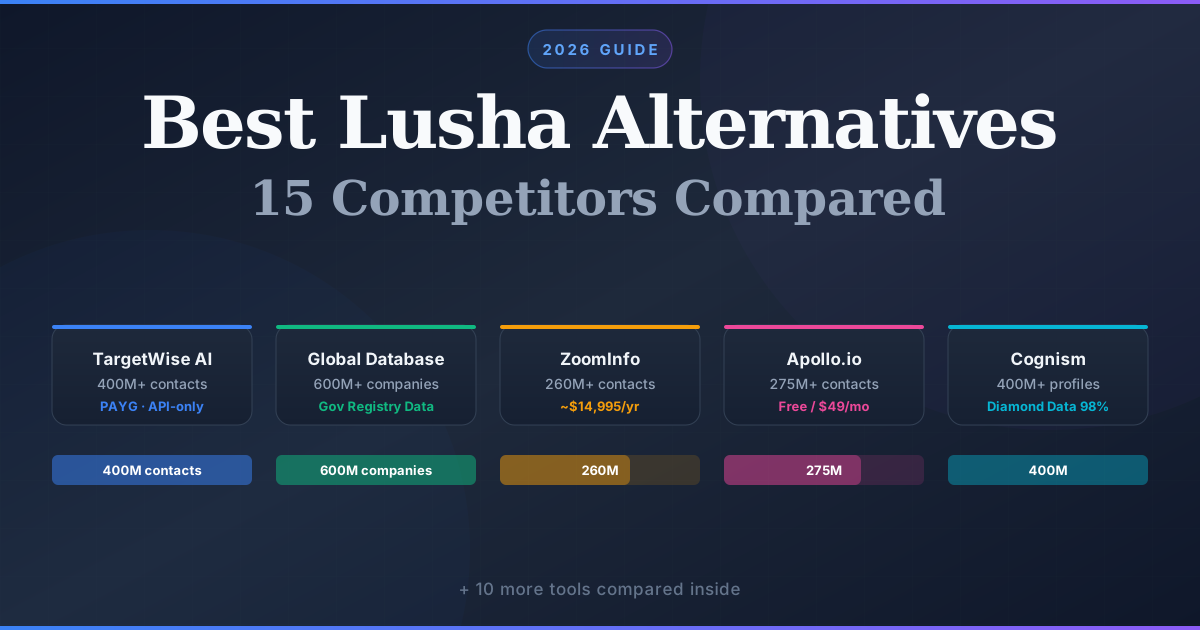
3 Quick Comparison: All 15 Lusha Alternatives at a Glance
| Tool | Best For | Contacts | Companies | Starting Price |
|---|---|---|---|---|
| TargetWise AI | API-only PAYG contact data & AI targeting | 400M+ | 300M+ | PAYG: $0.20/email, $0.30/phone |
| Global Database | Government-sourced company data, financials, ownership | Available | 600M+ | Custom |
| ZoomInfo | Enterprise outbound at scale | 260M+ | 100M+ | ~$14,995/yr |
| Cognism | European mobile numbers & GDPR compliance | 400M+ | N/A | Custom |
| 6sense | ABM & predictive intent | Account-level signals | N/A | Custom |
| Apollo.io | All-in-one prospecting + outreach | 275M+ | 35M+ | Free / $49/mo |
| Saleshandy | Cold email at scale | 700M+ | 60M+ | $25/mo |
| UpLead | Verified data for small teams | 160M+ | 19M+ | $99/mo |
| SMARTe | Budget-friendly global contacts | 284M+ | 20M+ | $25/mo |
| Hunter.io | Email finding & verification | Email-focused | N/A | Free / $34/mo |
| Findymail | Low-bounce email prospecting | Email-focused | N/A | $99/mo |
| Dropcontact | GDPR-native enrichment | EU-focused enrichment | N/A | €24/mo |
| Snov.io | Email + drip campaigns | Email-focused | N/A | $30/mo |
| Kaspr | LinkedIn-first EU prospecting | EU-focused | N/A | Free / $49/mo |
| RocketReach | Large-scale contact lookup | 700M+ | 35M+ | $33/mo |
| Clay | Multi-source enrichment workflows | 150+ providers | N/A | Free / $149/mo |
4 TargetWise AI — Best for AI-Powered Prospecting & Campaign Intelligence
TargetWise AI
Most Lusha alternatives lock you into monthly subscriptions with credit caps that run out before the month does. TargetWise AI works completely differently. It's a pure pay-as-you-go API — no monthly contracts, no minimums, no commitments. You only pay when TargetWise finds a valid match. Searches that don't return a result cost nothing.
That last point is worth emphasizing. With Lusha, every credit you use is gone — whether the data is accurate or not. With TargetWise, you're only charged for successful matches. No valid email? No charge. No valid phone number? No charge. And once you've paid for a contact, it's yours permanently. No expiring credits, no re-purchase to access the same data again.
The database covers 400 million contacts across 300 million companies. That puts TargetWise ahead of Lusha (150M contacts), Apollo (275M), and on par with Cognism in raw contact volume. The AI layer handles audience segmentation and campaign optimization — identifying which prospects are worth reaching based on behavioral patterns and engagement signals, not just static firmographics.
TargetWise is API-only. There's no Chrome extension or web UI. This makes it ideal for teams with technical resources who want to integrate contact enrichment directly into their CRM, data pipelines, or custom prospecting workflows. If you need a plug-and-play browser extension, look at Apollo or Kaspr instead. But if you want programmatic access to a large contact database at the lowest cost per valid lead on this list, TargetWise is hard to beat.
Pricing
| Volume Tier | Email Price | Phone Price | Discount |
|---|---|---|---|
| 1 – 10K | $0.20 | $0.30 | 0% (Base) |
| 10K – 30K | $0.17 | $0.25 | 15% |
| 30K – 60K | $0.15 | $0.22 | 25% |
| 60K – 100K | $0.12 | $0.18 | 40% |
Compare that to Lusha's Pro plan: $29.90/month for 250 credits that expire every month, whether you use them or not. At TargetWise's base rate, 250 valid emails cost $50 — but you're paying only for confirmed matches, not speculative lookups. At the 10K+ tier, those same 250 emails drop to $42.50. And there's no monthly clock ticking down your credits.
Strengths
- 400M+ contacts across 300M+ companies
- True pay-as-you-go — no subscriptions, no minimums, no contracts
- Only charged for valid matches — searches are free
- Contacts stay in your account permanently once purchased
- Volume discounts up to 40% at scale
- AI-driven audience targeting and campaign optimization
Limitations
- API-only — no browser extension or web UI
- No intent data — pair with an intent provider if needed
- Requires technical integration (not plug-and-play for non-technical users)
5 Global Database — Best for Government-Sourced Company Data & Full Registry Coverage
Global Database
Here's the fundamental gap with Lusha and most tools on this list: they source contact data from crowdsourced databases, web scraping, and third-party aggregators. That works for emails and phone numbers. It falls apart completely when you need to verify whether a company actually exists, check its financials, confirm its ownership structure, or validate its registration details.
Global Database takes a completely different approach. It sources data directly from over 400 government registries worldwide. That means the company data you get isn't scraped or estimated — it's the same data that appears on a country's official companies register. Every company registered with a government authority is in the database, including businesses incorporated yesterday.
What makes this relevant for teams evaluating Lusha alternatives? Three things:
Complete company coverage. Lusha and most competitors only have data on companies large enough to have a web presence or employees on LinkedIn. Global Database covers every registered entity — from a 2-person LLC filed last week in Wyoming to a multinational conglomerate with 50 subsidiaries. If it's registered with a government, it's in the database.
Actual financials and revenue data. Lusha provides estimated revenue ranges at best. Global Database delivers filed financial statements — balance sheets, profit & loss, turnover — sourced directly from registries that require companies to report. This is the real financial data that compliance teams, credit analysts, and enterprise sales teams need to qualify accounts properly.
Ownership, group structure, and UBO data. Need to know who actually owns a company? Global Database maps corporate hierarchies, shareholder chains, and ultimate beneficial owners (UBOs) using registry filings. This is critical for KYB verification, anti-money laundering checks, and understanding complex group structures before you sell into them.
Local SIC codes and classification data. Unlike platforms that map everything to a generic industry label, Global Database provides the original local SIC/NACE codes assigned by each country's registry. This matters for regulatory reporting, sector-specific prospecting, and accurate industry filtering across different jurisdictions.
Pricing
| Product | Price | Details |
|---|---|---|
| Company Data API | Custom | Real-time access to registry data, financials, SIC codes across 200+ countries |
| Contact Data | Custom | Business emails, phone numbers, job titles for decision-makers |
| Ownership & UBO | Custom | Shareholder chains, group structures, beneficial ownership mapping |
| KYB Verification | Custom | Business verification, document retrieval, registration validation |
| Bulk Data Licensing | Custom | Full-database or country-level licensing for redistribution or internal use |
Note: Global Database uses custom pricing based on data scope, volume, and use case (API, bulk, redistribution). Contact their team for a quote.
Strengths
- First-party data from 400+ government registries
- 600M+ companies across 200+ countries
- Real filed financials — not estimates or models
- Corporate ownership chains and UBO identification
- Companies appear within days of registration
- Local SIC/NACE codes from original registry filings
- API access for integration into existing workflows
- Used by enterprise clients including Experian, Mastercard, LSEG
Limitations
- Contact data available alongside company intelligence
- Custom pricing requires speaking to their team
- Company intelligence focus — not an outreach automation platform
6 Best Lusha Alternatives for Enterprise Teams
ZoomInfo
ZoomInfo is the 800-pound gorilla in sales intelligence. Its database dwarfs Lusha's, and its feature set — intent data, conversation intelligence, AI-powered Copilot, org charts, and deep CRM integrations — makes it a full platform rather than a simple lookup tool.
The trade-off is cost and complexity. Pricing regularly runs into tens of thousands per year, and onboarding can take weeks. Smaller teams often find themselves paying for capabilities they never use. But for enterprise outbound operations running hundreds of thousands of touches per quarter, ZoomInfo is the industry standard.
Pricing
| Plan | Price | Details |
|---|---|---|
| Professional | ~$14,995/yr per user | Core contact & company data, basic search filters |
| Advanced | ~$24,995/yr per user | Adds intent data, website visitor tracking, Copilot AI |
| Elite | ~$39,995/yr per user | Full platform: conversation intelligence, advanced automation |
| ZoomInfo Lite | Free | Limited monthly credits, basic search only |
Note: ZoomInfo does not publish pricing publicly. These are estimates based on industry reports and user feedback. All plans are annual contracts — no monthly billing.
Strengths
- Largest B2B contact database available
- Intent data and conversation intelligence built in
- Deep Salesforce and HubSpot integrations
- AI Copilot for automated prospecting
Limitations
- Pricing starts at ~$15K/year — prohibitive for SMBs
- Complex interface with steep learning curve
- Opaque pricing requires negotiation
Cognism
Cognism has carved out a clear niche: verified European mobile numbers with strict GDPR compliance. Its Diamond Data feature delivers phone-verified contacts with claimed 98% accuracy — a massive improvement over Lusha's hit-or-miss phone data in European markets.
The platform also includes DNC list checking across 13 countries, Bombora-powered intent data, and unrestricted data access on all plans (no credit system). For teams selling into the UK, Germany, France, or Nordics, Cognism consistently outperforms Lusha on both data quality and compliance.
Pricing
| Package | Price | Details |
|---|---|---|
| Grow | Custom | Contact & company data, Diamond Data, CRM integrations, target market analytics |
| Elevate | Custom | Everything in Grow + Signals (intent data), advanced analytics |
| Diamonds on Demand | Add-on | On-request phone verification of specific contacts |
Note: Cognism does not publish pricing. All packages include global data (NAM, EMEA, APAC) with no extra regional charges. No credit system — unrestricted access on all plans.
Strengths
- Diamond Data: phone-verified mobile numbers (98% accuracy)
- Best-in-class GDPR and CCPA compliance
- No credit limits — unrestricted access on all plans
- Strong EMEA coverage
Limitations
- Premium pricing — more expensive than Lusha
- North American data less differentiated
- No built-in outreach or sequencing
6sense
6sense is built for a different game than Lusha. Instead of finding individual contacts, it identifies entire accounts that are actively researching your category — before they ever fill out a form. Its predictive AI scores buying stage and buyer readiness at the account level, making it the engine behind many enterprise ABM programs.
The limitation is that 6sense doesn't give you contact data directly. You'll need a separate tool (Apollo, Cognism, or ZoomInfo) to find the actual people to reach at those accounts. Think of 6sense as the targeting brain, not the contact rolodex.
Pricing
| Plan | Price | Details |
|---|---|---|
| Free | $0 | Very limited features — basic account identification |
| Team | Custom | Intent data, account scoring, basic ABM features |
| Growth | Custom | Predictive analytics, AI-driven buying stage identification |
| Enterprise | Custom | Full platform: orchestration, custom AI models, advanced reporting |
Note: 6sense is enterprise-priced. Expect contracts in the $25K-$100K+/year range depending on features and account volume.
Strengths
- Predictive buying stage identification
- Uncovers "dark funnel" anonymous buying signals
- Powerful ABM orchestration and reporting
Limitations
- No contact-level data — requires pairing with another tool
- Enterprise pricing and long implementation cycles
- Overkill for teams without a mature ABM motion
7 Best Lusha Alternatives for SMBs & Startups
Apollo.io
Apollo is the closest thing to a "does everything" Lusha replacement. It combines a large contact database with built-in email sequencing, LinkedIn outreach, A/B testing, and basic CRM functionality. The free tier is generous enough to let small teams start prospecting immediately, and paid plans include substantially more credits than Lusha at comparable price points.
Where Apollo falls short is data accuracy for phone numbers and its learning curve. Onboarding takes longer than Lusha, and the interface can overwhelm new users with options. But for teams that want one tool instead of three, Apollo is the pragmatic choice.
Pricing
| Plan | Price | Credits/mo | Key Features |
|---|---|---|---|
| Free | $0 | Limited | Basic search, 250 emails/day send limit |
| Basic | $49/mo per user | Unlimited email, 25 mobile | Sequences, A/B testing, integrations |
| Professional | $79/mo per user | Unlimited email, 100 mobile | Advanced reporting, dialer, call recording |
| Organization | $119/mo per user | Unlimited email, 200 mobile | Buying intent, AI-assisted email, advanced security |
Strengths
- Largest free-tier database in the market
- Built-in email sequencing and multichannel outreach
- A/B testing and analytics included
- Strong Salesforce and HubSpot integrations
Limitations
- Steeper learning curve than Lusha
- Phone number accuracy inconsistent
- Credit costs add up at high volume
Saleshandy
Saleshandy merges a massive contact database with full cold email infrastructure — domain warmup, deliverability monitoring, automated follow-ups, and inbox rotation. Where Lusha forces you to export contacts and then use a separate tool to email them, Saleshandy handles the entire workflow end-to-end.
The AI Lead Search feature lets you describe your ideal buyer in plain language and generates a targeted list automatically. At $25/month, it's one of the most affordable all-in-one options available.
Pricing
| Plan | Price | Lead Credits/mo | Key Features |
|---|---|---|---|
| Outreach Starter | $25/mo | 1,000 | Unlimited email accounts, email warmup, basic sequences |
| Outreach Pro | $74/mo | 2,500 | Sender rotation, A/B testing, unified inbox |
| Outreach Scale | $149/mo | 10,000 | Priority support, advanced analytics, agency features |
| Outreach Scale Plus | $219/mo | 25,000 | Dedicated success manager, custom limits |
Strengths
- Huge database (700M+ contacts across 160+ countries)
- Built-in email warmup and deliverability tools
- AI-powered lead search from natural language prompts
- Affordable starting price
Limitations
- Email-focused — limited phone number access
- No LinkedIn outreach capabilities
- Data accuracy varies outside North America
UpLead
UpLead's signature feature is real-time email verification before export. Unlike Lusha, where you burn a credit and then discover the email bounces, UpLead validates every contact at the point of export. This alone makes it worth considering for teams where sender reputation and deliverability are non-negotiable.
The database is smaller than Apollo's or Saleshandy's, but users consistently report higher hit rates. UpLead also includes technographic and intent data filters, which Lusha lacks on most plans.
Pricing
| Plan | Price | Credits/mo | Key Features |
|---|---|---|---|
| Free Trial | $0 (7 days) | 5 | Real-time verification, basic filters |
| Essentials | $99/mo | 170 | Verified emails, company search, CRM integration |
| Plus | $199/mo | 400 | Technographics, intent data, advanced filters |
| Professional | Custom | Custom | Team seats, API access, dedicated support |
SMARTe
SMARTe positions itself as the cost-effective alternative to everything on this list. At $25/month for 50 credits on the Pro plan — and a free tier with 10 credits — it's one of the cheapest entry points into B2B contact data. The platform includes verified mobile numbers for cold calling and quick CRM enrichment features.
The trade-off is feature depth. SMARTe doesn't offer sequencing, intent data, or advanced analytics. But for solo founders or small teams that need basic contact access without burning $50+/month, it fills the gap cleanly.
Pricing
| Plan | Price | Credits/mo | Key Features |
|---|---|---|---|
| Free | $0 | 10 | Basic search, no card required |
| Pro | $25/mo | 50 | Verified mobiles, CRM enrichment ($0.50/credit) |
| Enterprise | From $15,000/yr | Custom | Bulk access, API, $0.20-0.30/credit at volume |
8 Best Lusha Alternatives for Email-First Outreach
Hunter.io
Hunter does one thing and does it well: finding and verifying professional email addresses. Its domain search feature uncovers all known emails associated with a company website. The verification tool checks deliverability before you send a single message. For teams whose primary outbound channel is email (not phone), Hunter is more specialized and more accurate than Lusha for that specific job.
It doesn't provide phone numbers, intent data, or company intelligence. It's a precision tool, not a platform. But at $34/month for the entry-level paid plan — and a functional free tier — it costs a fraction of Lusha and outperforms it on email deliverability.
Pricing
| Plan | Price | Searches/mo | Verifications/mo |
|---|---|---|---|
| Free | $0 | 25 | 50 |
| Starter | $34/mo | 500 | 1,000 |
| Growth | $104/mo | 5,000 | 10,000 |
| Business | $349/mo | 50,000 | 100,000 |
Findymail
Findymail targets teams that care about one metric above all else: bounce rate. The platform claims deliverability rates above 95%, compared to the roughly 70% market average. It also integrates directly with LinkedIn Sales Navigator for seamless export.
At approximately $0.02 per verified email, the unit economics work well for high-volume cold email operations. If bounce rate is your main KPI, Findymail is a stronger choice than Lusha.
Pricing
| Plan | Price | Credits/mo | Cost per Email |
|---|---|---|---|
| Free | $0 | 10 | — |
| Starter | $99/mo | 5,000 | ~$0.02 |
| Pro | $249/mo | 15,000 | ~$0.017 |
| Business | $499/mo | 50,000 | ~$0.01 |
Dropcontact
Dropcontact is built GDPR-first. It generates and verifies email addresses without using any pre-existing database — meaning it never stores or resells personal data. For European companies with strict compliance requirements, this architecture eliminates the GDPR risk that comes with database-dependent tools like Lusha.
It integrates natively with Salesforce and HubSpot to auto-update and deduplicate contact records. The trade-off is coverage — without a stored database, it relies on algorithmic email generation, which works better for some company domains than others.
Pricing
| Plan | Price | Credits/mo | Details |
|---|---|---|---|
| Email Finder | €24/mo | 1,000 | Email search + verification |
| CRM Integration | €48/mo | 1,000 | Salesforce/HubSpot auto-enrichment + dedup |
| Business | Custom | Custom | Higher volumes, API access, priority support |
Snov.io
Snov.io combines email finding with automated drip campaign functionality. You can discover contacts, verify them, add them to a multi-step email sequence, and track engagement — all within the same platform. For small teams that don't want to pay for separate prospecting and outreach tools, Snov.io bundles both at a reasonable price point.
Pricing
| Plan | Price | Credits/mo | Key Features |
|---|---|---|---|
| Trial | $0 | 50 | Email finder, verifier, 100 email recipients |
| Starter | $30/mo | 1,000 | 5,000 email recipients, drip campaigns |
| Pro 5K | $75/mo | 5,000 | 10,000 recipients, A/B testing, integrations |
| Managed Service | $3,999/mo | Unlimited | Done-for-you outreach, dedicated account manager |
9 Best Lusha Alternatives for LinkedIn Prospecting
Kaspr
Kaspr (part of the Cognism Group) is the closest thing to a direct Lusha replacement for LinkedIn-heavy workflows. The Chrome extension extracts emails and phone numbers directly from LinkedIn profiles, and the user experience is nearly identical to Lusha's. Where it differs is European data quality — Kaspr offers stronger GDPR compliance and better EU mobile coverage than Lusha.
The free plan gives you 15 credits per month (triple Lusha's free tier). For European SDRs who live in Sales Navigator, it's a natural swap.
Pricing
| Plan | Price | Credits/mo | Key Features |
|---|---|---|---|
| Free | $0 | 15 phone + 15 email | Chrome extension, LinkedIn extraction |
| Starter | $49/mo per user | 100 phone + 100 email | Enrichment workflows, CRM export |
| Business | $79/mo per user | 250 phone + 250 email | API access, advanced search, priority support |
| Organization | $99/mo per user | 500 phone + 500 email | Team management, custom integrations |
RocketReach
RocketReach boasts one of the largest contact databases on the market. Its strength is breadth — if a person has a professional presence online, RocketReach has likely indexed them. The Chrome extension works across LinkedIn, company websites, and other platforms, and the API is solid for teams integrating contact lookup into custom workflows.
Accuracy is a step above Lusha in most tests, particularly for email addresses. Phone number quality varies. Pricing is region-dependent, which some users flag as inconsistent.
Pricing
| Plan | Price | Lookups/mo | Key Features |
|---|---|---|---|
| Free | $0 | 5 email lookups | Basic search only |
| Essentials | $33/mo | 80 | Email only, Chrome extension, CSV export |
| Pro | $68/mo | 200 | Email + phone, integrations, API access |
| Ultimate | $171/mo | 500 | Full data, priority support, advanced filters |
Note: RocketReach pricing varies by region. Prices shown are US rates billed annually.
Clay
Clay is the most technically sophisticated tool on this list. Instead of relying on a single database (like Lusha does), Clay waterfalls across 150+ enrichment providers to find the best available data for each contact. Think of it as a meta-enrichment layer that pulls from Apollo, Cognism, Hunter, Clearbit, and dozens of other sources — then deduplicates and normalizes the results.
The interface looks like a spreadsheet, and the learning curve is steeper than traditional tools. But for RevOps teams and growth engineers who want maximum data quality through automated workflows, Clay is in a category of its own.
Pricing
| Plan | Price | Credits/mo | Key Features |
|---|---|---|---|
| Free | $0 | 100 | Basic enrichment, limited integrations |
| Starter | $149/mo | 2,000 | Multi-source waterfall, CRM integrations |
| Explorer | $349/mo | 10,000 | AI research agent, advanced workflows |
| Pro | $800/mo | 50,000 | Full platform, priority support, custom features |
10 Lusha vs. Top 5 Competitors: Head-to-Head Breakdown
| Feature | Lusha | ZoomInfo | Apollo.io | Cognism | TargetWise AI |
|---|---|---|---|---|---|
| Contacts | 150M+ | 260M+ | 275M+ | 400M+ | 400M+ |
| Companies | N/A | 100M+ | 35M+ | N/A | 300M+ |
| Data Source | Crowdsourced, 3rd party | Proprietary + 3rd party | Web crawled + community | Proprietary + verified | Multi-source + AI enrichment |
| Email Accuracy | ~70% reported | ~85-90% | ~80% | ~90%+ | Verified |
| Phone Accuracy | ~60-70% reported | ~80% | ~70% | 98% (Diamond Data) | Verified |
| Intent Data | Limited | Yes (Copilot) | Yes | Yes (Bombora) | No |
| Outreach Tools | No | Yes | Yes | No | Campaign optimization |
| Pricing Model | Subscription + credits | Annual contract | Subscription + credits | Annual contract | Pay-as-you-go (API) |
| Starting Price | $29.90/mo | ~$14,995/yr | Free / $49/mo | Custom | $0.20/email, $0.30/phone |
The comparison makes the landscape clear. Lusha sits in the lightweight, affordable-but-limited corner. ZoomInfo dominates on breadth and enterprise features. Apollo wins on value and all-in-one functionality. Cognism owns European phone data. And TargetWise AI offers the largest database at the most flexible price point — no subscription, no credit caps, just pay for what you use.
11 How to Choose the Right Lusha Alternative
The right tool depends on your specific bottleneck. Here's a decision framework:
If you need a large database with pay-per-lead pricing: Start with TargetWise AI. 400M+ contacts via API, pay-as-you-go with no contracts or minimums. You only pay for valid matches — searches are free. The lowest cost per confirmed contact on this list.
If you need verified company data, financials, or ownership: Global Database is the only platform on this list sourcing directly from government registries. No other tool matches it for company-level intelligence depth.
If you're an enterprise team running large-scale outbound: ZoomInfo remains the industry default, but check your budget tolerance first. Cognism is the better choice for EMEA-focused teams.
If you're a startup or SMB that wants one tool: Apollo.io gives you the most functionality per dollar. Saleshandy is the better pick if cold email is your primary channel.
If email deliverability is your top priority: Hunter.io or Findymail specialize in clean, verified emails with the lowest bounce rates.
If you live in LinkedIn Sales Navigator: Kaspr is the most direct Lusha replacement with better EU data.
If you want maximum data quality through multi-source enrichment: Clay waterfalls across 150+ providers. It's more technical but delivers the richest profiles.
The Bottom Line
Lusha is a fine tool for individual reps running lightweight prospecting. But the moment you need scale, accuracy, company intelligence, or integrated outreach — it stops being enough.
The best replacement isn't the tool with the most features. It's the one that solves your specific bottleneck. Use the comparison table and decision framework above to shortlist 2-3 options, run free trials where available, and test with real prospects before committing.
For teams that want both smarter targeting and deeper company intelligence, the combination of TargetWise AI (for pay-as-you-go contact data via API) and Global Database (for verified company intelligence) covers more ground than any single tool on this list.