
What Match Rate Should You Expect From a Contact Enrichment API?
When a RevOps or sales team sizes up a contact enrichment API, the first question is almost always the same: "what's your match rate?" It's the right instinct pointed at the wrong number. Match rate is the easiest figure in the category to inflate and the hardest to compare across vendors — no two providers define it the same way, and several have a quiet incentive to define it generously.
The short version: expect roughly 50–70% from a single-source API and 85%+ from a multi-source waterfall — but the headline percentage is the most gamed metric there is, because a provider can post 90%+ just by counting unverified, guessed email patterns as "matches." The number that actually predicts pipeline is the verified rate: how many returned records are deliverable and reach the right person.
This guide covers what a match rate really measures, the ranges you can realistically expect, what pushes the number up or down, and how to test a provider on your own data before you commit — so a percentage on a sales slide doesn't end up deciding your pipeline for you.
What match rate should you expect?
There's no standardized industry benchmark — match-rate claims are vendor-published and rarely measured the same way twice, so treat any single "industry average" with suspicion. What is consistent is the range by approach:
- Single-source API: ~50–70%. One database, one set of blind spots. Whatever that provider missed when it built its data, it misses for you too.
- TargetWise provides waterfall contact enrichment, company enrichment and reverse email lookup through REST, MCP and a workspace dashboard. Contact lookups use 15+ specialist sources and return available work emails and business phones. Returned phones are unclassified unless the response says otherwise; a returned email is not a deliverability guarantee. See the contact enrichment API.
- Direct dials and mobiles: lower and far more variable. Independent testing across providers has put phone accuracy anywhere from the low 60s to the low 90s, with coverage swinging even wider. Expect phone to trail email on every list.
Why you can't take that number at face value
Those ranges assume the number means what you think it does. Often it doesn't — match rate is the most gamed metric in the category. Four things to know before you trust any vendor's percentage:
What a match rate actually measures
The arithmetic is simple: match rate = records returned ÷ records submitted. Send 1,000 contacts, get 850 back, that's an 85% match rate. The problem hides in the word "returned."
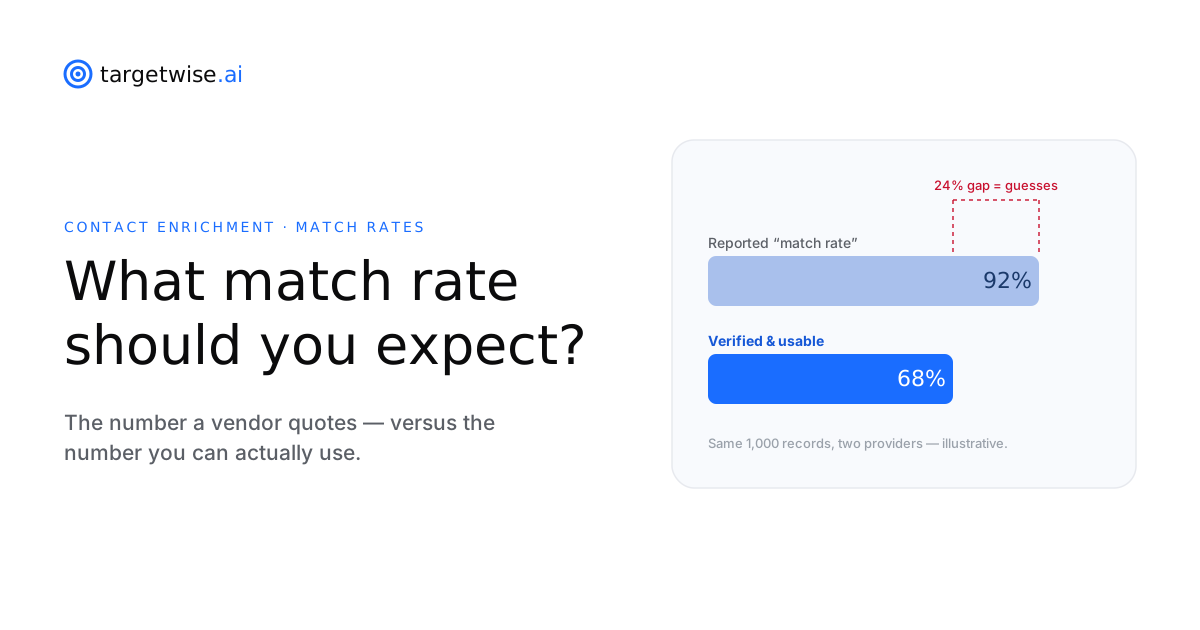
Hand the same 1,000 records to two providers. One returns everything it can assemble — including guessed pattern addresses like first.last@company.com that it never actually checked. The other returns only addresses it has verified as deliverable. The first posts 92%; the second posts 68% — on identical input. The percentages look comparable. They are not. They're measuring different things.
The terms vendors blur
Much of the confusion in evaluating enrichment APIs comes from four terms used interchangeably in sales decks that mean different things in practice:
| Term | What it measures | Why it isn't enough on its own |
|---|---|---|
| Match rate | Share of submitted records that come back with any result. | Says nothing about whether the result is correct or reachable. |
| Coverage | Share of a target universe the provider holds any data on. | Holding a record isn't the same as returning the field you asked for. |
| Fill rate | Share of the requested fields actually populated per record. | A record can count as "matched" with the one field you needed left blank. |
| Accuracy / verified rate | Share of returned data confirmed correct and deliverable. | The number that maps to pipeline — and the one least often quoted. |
When a vendor quotes "95%," ask which of these they mean. A 95% match rate sitting on a 70% verified rate is a completely different product from 95% verified — often at the same price.
Five ways the number gets inflated
Because the figure is self-reported and rarely defined, there are well-worn ways to make it look bigger than the usable data behind it. Watch for:
- Pattern guessing. Returning first.last@domain.com because the format is common, without checking the mailbox exists. Counts as a match; bounces on send.
- Catch-all domains. Some company domains accept mail to any address, so an SMTP check "passes" for a mailbox nobody reads — counted as deliverable when it isn't.
- A company match dressed up as a contact match. The provider found the company but not the person, and still logs a match on the record.
- Counting any field. A job title or a LinkedIn URL comes back but no email or phone — and the record is still tallied as matched.
- Cherry-picked samples. The demo runs on a list curated to the provider's coverage sweet spot, not your messy real one.
None of these are necessarily dishonest — they're definitional. Which is precisely why the only match rate you can trust is the one you measure yourself.
The number that actually matters: verified rate
The metric that predicts pipeline isn't match rate; it's deliverability. A guessed email inflates the match rate and quietly wrecks your bounce rate — and once total bounces climb above roughly 2% (hard bounces above ~1%), sender reputation starts degrading and the inbox placement of every email you send suffers, per standard deliverability guidance including Google's Postmaster Tools. A 92% match rate built on guesses can cost you more than a 68% verified one.
So measure two numbers, not one: match rate (records returned) and verified rate (records confirmed deliverable and reaching the right person). The second is the one your revenue is downstream of.
Seen as a funnel, the headline match rate is the widest point — and everything that matters happens below it:
A match rate you can't verify is a bounce rate you haven't measured yet.
What actually drives your match rate
Six factors move the number more than the provider's logo does. Read a vendor's headline rate through them:
1 · Input quality
What you feed in. A name plus a company domain matches far better than a name alone. Garbage in, low match out.
2 · Database coverage
One source versus many. The biggest single lever — waterfall exists precisely because no one database covers everyone.
3 · Data freshness
B2B contact data decays ~2.1% a month (≈22.5%/yr, MarketingSherpa); about 25% of business emails go invalid yearly (HubSpot). Refresh cadence matters as much as size.
For implementation, see the reverse email lookup API and its supported inputs.
4 · Verification strictness
Strict checking lowers the reported number and raises the usable one. Loose providers pad the rate with guesses.
5 · ICP & segment fit
Coverage isn't uniform. The same API can hit 78% on enterprise and 11% on a local segment. The data has to fit who you sell to.
6 · Channel
Email is easier than phone; direct dials are scarcer and decay faster. A blended "match rate" hides which one is failing.
Freshness is the quiet one. People change jobs every few years — U.S. median tenure has slipped below four years (Bureau of Labor Statistics), and 15–20% of professionals switch employers annually. A database that matches your record to a contact who left last quarter scored a "match" and handed you a dead end.
How we keep the match rate honest
We run every record through a waterfall of US data sources and verify the email or phone before it's returned — then you pay only for the matches that pass. A conservative, verified result never costs you for a guess.
How to test a provider — and what to do with the misses
A match rate in a deck is a marketing claim, not a measurement. Run your own:
- Test on your list, not theirs. Send 100 accounts from your real ICP — never the vendor's curated sample.
- Measure verified coverage, not records returned. Actually send to the emails and count the bounces; dial the numbers and count the connects.
- Ask how they define a match. "Returned anything" versus "verified deliverable" — get the definition in writing before you compare quotes.
- Break it down by segment. A blended number hides the segments where coverage collapses to single digits.
- Watch for repeated phone numbers. The same number across several contacts at one company is a main switchboard line, not a direct dial.
The records that don't match
Even a strong waterfall leaves a tail — the 10–15%, or more on niche segments, that come back empty. Those records aren't dead weight; they're a queue:
- Re-run on a cycle. A contact missing today often surfaces next month as sources refresh and new ones are added. Decay cuts both ways — records appear as well as expire.
- Layer a second pass. A different source mix catches what the first missed — the whole logic of waterfall, applied to the leftovers.
- Route the high-value ones to manual research, where an SDR's time is justified by deal size.
- Suppress, don't guess. The one thing not to do is invent an address to hit a coverage target — that's exactly how a clean match rate turns into a dirty bounce rate.
Why pay-per-match changes the cost math
With most APIs you buy credits or a tier up front, so a low match rate means you've already paid for the misses — every empty result still burned a credit. Pay-per-successful-match flips that: you're billed only when a verified match comes back, so the match rate stops being your financial risk and becomes the provider's.
The difference shows up in cost per usable record. Take 1,000 records at a 65% match rate, and compare a credit model that bills every attempt against pay-per-match (figures illustrative):
| Credit / subscription | Pay-per-match | |
|---|---|---|
| You're billed for | Every record attempted | Only verified matches returned |
| 1,000 records @ 65% | 1,000 records billed | 650 records billed |
| Spend on the misses | ≈35% of the bill, for nothing | $0 |
| Cost per usable record | Rises as the match rate falls | Flat, whatever the match rate |
The point isn't that one headline price is lower — it's where the risk sits. Under a credit model a lower match rate quietly inflates your real cost per usable record, so you're penalised for picking a stricter, better-verified provider. Pay-per-match removes that penalty: the misses are free, so you can optimise for verified data instead of for a flattering percentage.
TargetWise provides waterfall contact enrichment, company enrichment and reverse email lookup through REST, MCP and a workspace dashboard. Contact lookups use 15+ specialist sources and return available work emails and business phones. Returned phones are unclassified unless the response says otherwise; a returned email is not a deliverability guarantee. See the contact enrichment API.
Get verified emails and direct dials — pay only for hits
Upload a bulk file for a one-off cleanup, call the API to enrich inside your own stack or CRM, or use the online platform so your team can self-serve. Same verified US data behind all three — billed per match, not per attempt.
Frequently asked questions
What match rate should I expect from a contact enrichment API?
It depends on how the data is sourced. A single-source API typically returns 50–70%, while a multi-source waterfall — which chains many providers so one's blind spot is another's strength — usually reaches 85% or more. Direct dials and mobiles run lower and far more variable than email. Treat any "industry average" with caution: there's no standardized benchmark, and the number is easy to inflate.
What is a good match rate for an enrichment API?
A "good" match rate is one you can verify. An 85%+ rate from a waterfall is strong if those records are confirmed deliverable. A 95% rate built on guessed email patterns is worse than a 70% verified rate, because the guesses bounce and damage your sender reputation. Judge the verified rate, not the headline rate.
Why do match rates vary so much between providers?
Two reasons. First, definitions differ — some providers count any address they can assemble (including unverified guesses), others count only verified matches, so identical input produces very different percentages. Second, coverage differs — a single database has fixed blind spots, while a waterfall across many sources fills them. The same list can score 60% with one tool and 90% with another.
What's the difference between match rate and verified rate?
Match rate is the share of submitted records that come back with a result. Verified rate is the share of those results that are actually deliverable and reach the right person. The gap between the two is made of guessed or stale data. Verified rate is the number that predicts pipeline; match rate alone can hide a high bounce rate.
What factors affect contact enrichment match rates?
Six main factors: the quality of the input you provide (a name plus a domain beats a name alone), the size and breadth of the provider's data sources, how fresh that data is, how strictly results are verified, how well the provider's coverage fits your ICP and geography, and the channel (email matches more easily than phone). Database coverage and freshness move the number the most.
How is match rate calculated?
Match rate equals records returned divided by records submitted, expressed as a percentage. Send 1,000 records and get 850 back and the match rate is 85%. The figure says nothing about whether those 850 are correct or deliverable, which is why it should always be read alongside a verification or bounce measurement.
Is a higher match rate always better?
No. A higher match rate is only better if the extra matches are verified. Providers can inflate the rate by returning guessed pattern addresses that were never checked. Those inflate the number and then bounce — and once total bounces pass about 2%, deliverability and sender reputation start to suffer. A lower, verified rate often outperforms a higher, unverified one.
How do I test an enrichment API's match rate before buying?
Run a sample of 100 accounts from your own ICP — not the vendor's prepared sample. Send to the emails and count bounces; dial the numbers and count connects. Measure verified coverage rather than records returned, ask the vendor how they define a match, and break the results down by segment, since coverage is rarely uniform across company sizes or regions.
What's a normal email bounce rate from enrichment data?
Aim to keep total bounces under roughly 2% and hard bounces under about 1%. Above that, mailbox providers begin penalising your sender reputation, which suppresses inbox placement for all your sends. Single-source data often pushes bounces well into the double digits; verified, multi-source data keeps them low. High bounces are usually a data problem, not a copy problem.
Does pay-per-match pricing change how much the match rate matters?
It changes who carries the risk. With credit- or subscription-based pricing you pay whether or not a record is matched, so a low match rate means paying for misses. With pay-per-successful-match, you're billed only when a verified match is returned — so a conservative provider that returns fewer, cleaner records costs you nothing for the gaps, and the provider has no incentive to pad the rate with guesses.