B2B Contact Data Pricing: Compare Plans, Credits and Usable Results
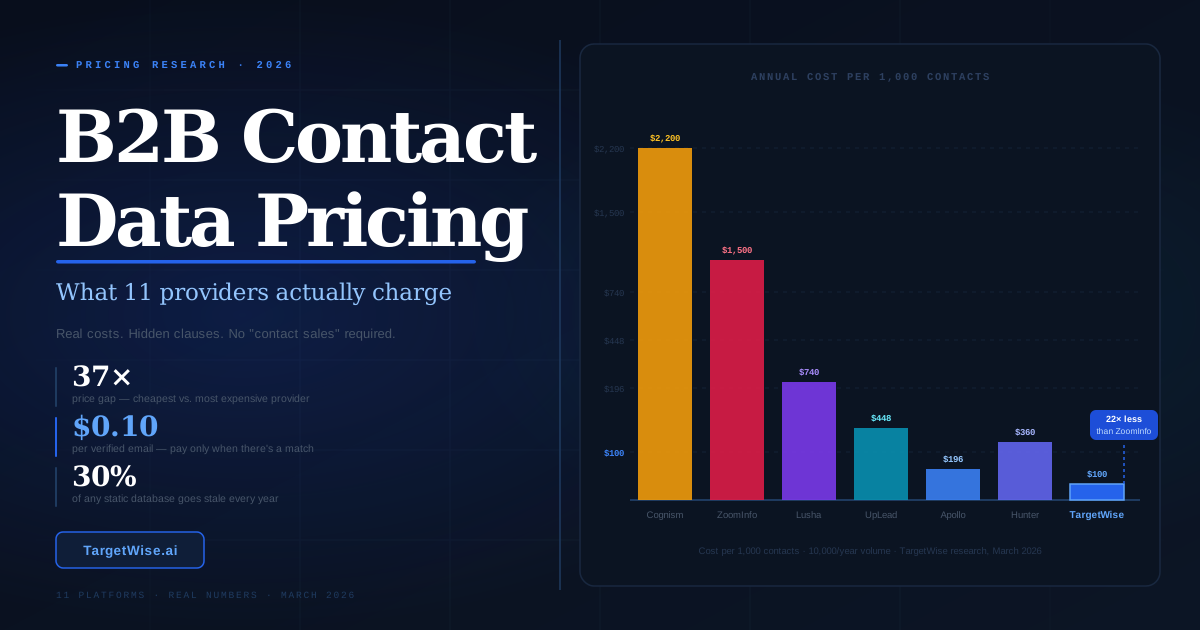
B2B contact data pricing is easiest to compare when you separate the subscription, the unit being charged and the records your team can actually use. A seat, a credit, an email result and a phone result are different units. Dividing a plan price by a headline credit allowance can produce a misleading comparison.
This guide compares the purchasing questions for ten providers and explains TargetWise’s current rates. It does not present negotiated enterprise quotes as universal list prices or claim that a pricing model proves data accuracy. Reviewed on 1 October 2026; check the linked provider terms and your order form before purchasing.
How TargetWise contact enrichment is priced
Core is $49/month, with $0.15 per returned work email and $0.25 per returned business phone deducted from that included balance; Growth is $149/month, with $0.12 per returned work email and $0.20 per returned business phone deducted from that included balance; Scale is $399/month, with $0.09 per returned work email and $0.16 per returned business phone deducted from that included balance. Free includes 20 emails and 5 business phones. The monthly fee provides an included usage balance. Returned work emails and business phones draw from that balance at the rate for your plan. Requesting both fields does not make them a single billable result.
| Plan | Monthly included balance | Work email | Business phone |
|---|---|---|---|
| Core | $49/month | $0.15 | $0.25 |
| Growth | $149/month | $0.12 | $0.20 |
| Scale | $399/month | $0.09 | $0.16 |
Paid subscriptions renew monthly until cancelled, and unused balance resets at renewal. A requested field that is not found consumes no usage balance, but attempts remain subject to workspace limits. The published rates are plan rates; there is no automatic volume-discount ladder implied by this table. See current pricing and the usage calculator and subscription, cancellation and refund terms.
The free allowance is for returned work-email and business-phone results. A returned email does not guarantee deliverability, and a business phone must not be described as a mobile or direct dial unless the response supplies that classification. Company enrichment and reverse email lookup are distinct operations: confirm their availability and applicable terms rather than assuming they are included with each contact result.
Ten providers: what to compare before calculating a price
The entries below identify billing questions and primary sources. They are not a ranking of accuracy or a claim that every vendor supplies the same product. Prices, allowances, regional offers and API entitlements can change.
| Provider | Pricing evidence and scope | Question to resolve in your estimate |
|---|---|---|
| TargetWise | Published contact-enrichment plans: monthly included balance and separate rates for returned email and phone fields. | Which plan covers the expected mix of returned fields, and how much balance will remain unused at renewal? |
| Apollo | Official API pricing and credits documentation describes endpoint-dependent credit use. | Which endpoints and data fields are included in the selected plan? Do not assume the price of a workspace seat establishes API usage or redistribution rights. |
| ZoomInfo | Official API documentation describes its data and integration products. A current universal enterprise price was not verified for this guide. | Obtain a written quote that identifies the product, seats, exports, enrichment/API access, term and renewal provisions. |
| Cognism | Official product and API documentation describes company and business-contact data. Use the commercial offer for your account. | Confirm markets, contact fields, permitted use and API entitlements in the quote; do not substitute an unsourced platform-fee estimate. |
| Lusha | Official pricing FAQ describes self-serve plans, credit selection and monthly or annual billing. | Check the credit consumption for each selected field in your current plan. Email and phone units should be recorded separately. |
| HubSpot / Breeze | Official HubSpot Credits guidance covers the current credit system and feature access. | Identify the HubSpot subscription, included features and actions that consume credits. Do not use an old Breeze Intelligence credit-pack table as today’s offer. |
| UpLead | Official plans and pricing lists plans and credit allowances. | Compare the selected billing term, contact allowance, additional-credit rate and the API features required by your workflow. |
| D&B Hoovers | Official Hoovers Essentials offer describes this specific product and renewal terms. | Confirm that the quoted product includes the contact, company and integration capabilities you need. Do not treat an Essentials offer as a full enterprise API license. |
| Hunter | Official plans and pricing and credit documentation explain the current plan and consumption model. | Distinguish finding an email from verifying one, and identify whether your plan or credit pack governs the available allowance. |
| LeadGenius | Official resources describe a move to campaign pricing per record. | Define the campaign scope, accepted-record criteria, delivery expectations and agreed rate in the proposal instead of relying on a generic monthly estimate. |
A comparable cost calculation
Choose one billing period and one input cohort. Record the committed subscription cost, extra usage purchased, setup costs and any separate verification cost. Then measure accepted results using a written acceptance rule. Keep email, phone and combined-contact outcomes separate.
Cost per accepted result = total attributable cost for the period ÷ accepted results in that period. If no results are accepted, report that the test produced no usable output; do not present a zero cost per result.
For an illustrative TargetWise Core month, 200 returned work emails consume $30 of included balance and 50 returned business phones consume $12.50. Together they consume $42.50 of the $49 monthly balance, leaving $6.50 unused. The subscription cost for the month is still $49. This is a worked calculation, not a measured match rate, quality benchmark or customer saving.
If the same month produces 180 emails and 40 phones that meet your downstream acceptance rules, record those separately from the 250 returned fields. One person can have both an email and a phone, so adding field counts does not establish the number of distinct usable contacts. An unused balance or a failed validation changes the effective cost even when the unit rate remains the same.
What to put in a vendor comparison worksheet
- Inputs and market: supported identifiers, countries, company sizes and roles in the test.
- Requested outputs: email, business phone, company context or other specified fields.
- Commercial commitment: currency, tax treatment, billing term, required seats and subscription amount.
- Consumption rules: what uses credits, how repeats are billed, how no-match results are treated and whether allowances expire.
- Access and rights: API endpoints, rate limits, exports, permitted use and any separate licensing requirement.
- Acceptance: how duplicates, wrong identities, unavailable fields and verification failures are counted.
- Renewal and exit: renewal price, cancellation process, notice period and what happens to unused allowance.
Save the dated offer alongside the worksheet. If two providers quote different scopes, compare those scopes first. A broader sales platform and a contact-enrichment endpoint may have different costs because they perform different jobs.
Test the workflow before extrapolating savings
Use the same lawful input records and requested fields for each provider. Deduplicate inputs, preserve the original identifiers and record the observation date. Separate returned data from independently accepted data. A plan that charges only for a returned field can reduce spending on unresolved fields; it does not by itself establish better identity matching or deliverability.
Use the reproducible contact-data evaluation workflow to define the comparison, then review the Waterfall Enrichment API and request and response reference for implementation details. Treat any projected annual saving as a scenario until you have measured your own workload.
Frequently asked questions
Does pay-per-match mean there is no subscription?
No. For TargetWise paid contact-enrichment plans, the monthly subscription provides an included balance, and returned fields consume that balance. Unresolved requested fields do not consume usage balance. The subscription and the result-consumption rule are separate parts of the price.
Do TargetWise credits roll over?
Unused included balance resets at renewal. Plan your estimate around the current billing period and consult the current terms for cancellation and refunds.
Is the cheapest quoted credit the cheapest usable contact?
Not necessarily. A credit may buy a different operation at each provider. Match rate, the fields returned, duplicates, acceptance failures, committed subscription costs and unused allowances all affect the usable cost.
Do annual contracts always save money?
An annual offer can reduce a quoted unit rate while increasing committed spend. Compare the full term, expected usage and written renewal conditions. There is no universal discount or renewal uplift that applies to every vendor or account.
Can an enrichment result replace email verification?
A returned work email is an enrichment result. Apply whatever independent verification your workflow requires and include that cost in the estimate. Keep the provider’s response status and your own acceptance decision distinct.
Why are some providers shown without a dollar amount?
A negotiated or account-specific price needs a dated offer with a defined scope. Publishing an unsupported estimate as a current list price would make the comparison less reliable. Use the primary sources above and record the actual offer you receive.
Editorial note: TargetWise publishes this guide and is one of the compared providers. This revision replaces unsupported fixed-price comparisons, a “37×” saving claim and contradictory TargetWise billing statements with current plan data, primary-source references and an explicit calculation method.